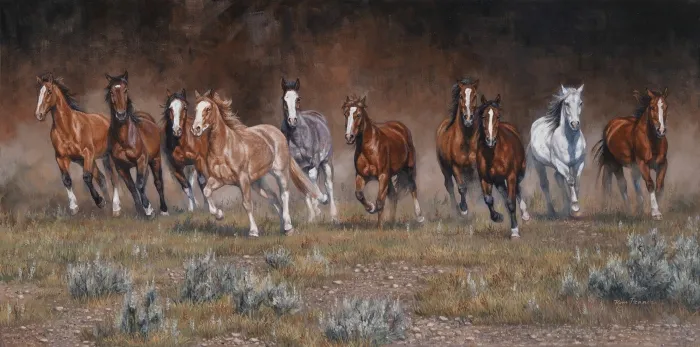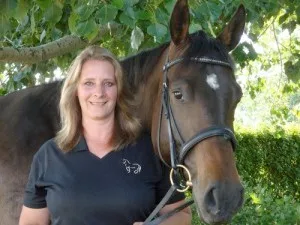
One of the earliest sparks in Kim Penner’s life with horses was a card. She was only two or three when an aunt gave her a card bearing the image of a horse. Long before she could have imagined a career in art, that small picture gave her a horse she could hold in her hands.
Many years later, the story came quietly full circle.
In 2004, the greeting-card company Leanin’ Tree discovered Kim’s work and selected three paintings for its cards. The request was unexpected. By then, she had spent years painting horses, exhibiting at equestrian events and building a body of original work. Licensing introduced those paintings to people who might never encounter them in a gallery or at a show.
That reach has continued through greeting cards, stationery, calendars and puzzles. A painting that begins alone in Kim’s Alberta studio can eventually become part of someone’s birthday message, winter tradition, kitchen wall or evening around a puzzle table.
What it means to license a painting
Licensing allows an approved company to reproduce an artwork for a defined product or use while the artist retains the copyright. The manufacturer produces and distributes that item; it does not purchase the original painting or acquire unlimited ownership of the image.
That distinction matters. An original remains a one-of-a-kind artwork. A signed limited-edition print belongs to a declared edition produced for collectors. A licensed card, calendar or puzzle is a separate reproduction made for a different purpose and audience.
Each format changes the encounter with the image. A card is personal and brief. A calendar returns to the wall every day for a month. A puzzle turns one scene into hundreds of small observations. None replaces the original, but each offers another way for the painting to enter a person’s life.
Greeting cards: where the circle began
The Leanin’ Tree relationship is especially fitting because a horse card played such an early role in Kim’s own story. More than two decades after the company first selected her work, Leanin’ Tree continues to include Kim in its artist directory.
A greeting card is modest in scale, yet intimate in use. Someone chooses it for another person, writes inside it and sends the image into a relationship. Equine art often carries ideas of freedom, loyalty, strength, tenderness or home without needing to state them directly. That makes a horse painting particularly suited to a message exchanged between people.
It is also a reminder that people do not always discover an artist by first seeing a large original. Sometimes the introduction is a card on a mantel or an image kept in a drawer because it meant something.
Puzzles: an image seen piece by piece
Cobble Hill has released several puzzles credited to Kim, including Horse Meadow, Freedom, Winter’s Beauty, Friends Forever and On the Rocks. The formats have ranged from a 275-piece easy-handling edition to 500- and 1,000-piece puzzles.
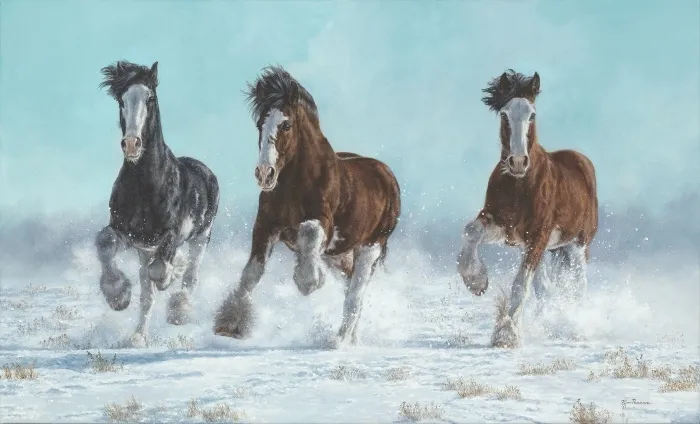
Puzzles invite a different kind of looking. Someone who might take in a painting in seconds begins to notice the shape of a snowbank, the break of water around a horse’s legs, the colour change across a distant mountain and the small intervals between animals in a herd. The composition has to work as a whole, but it also needs to hold attention fragment by fragment.
That slow attention suits many of Kim’s subjects. Her horse paintings are built from relationships: animal and landscape, movement and stillness, one horse and another. Reassembling an image makes those relationships visible in a new way.
Calendars: paintings that travel internationally
The Hoof Beats wall calendar has carried collections of Kim’s equine paintings into homes well beyond Canada. Retail listings document editions for 2026 and 2027 from Pine Ridge Art, continuing a product history that has helped introduce the work to an international audience.
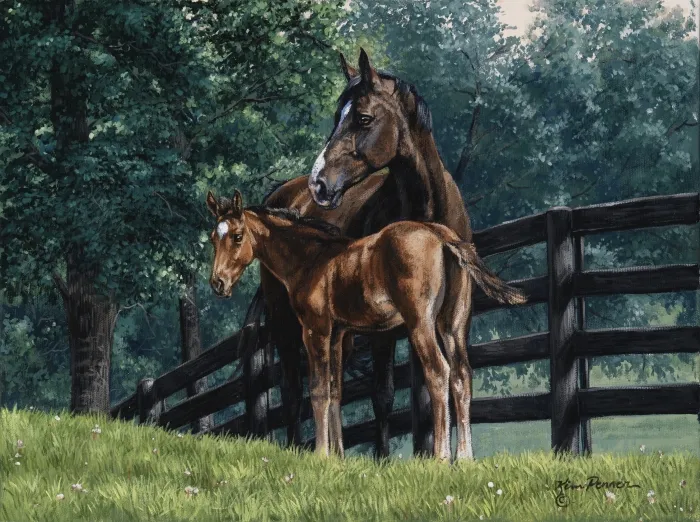
A calendar creates a year-long sequence rather than a single view. A winter herd can give way to spring pasture, mountain water, autumn colour and the close companionship of mares and foals. Seen together, the paintings reveal the range within equine art: power and quietness, the cultivated world and open country, portrait and panorama.
The international listings are also a tangible measure of reach. A collector may know Kim’s work from a Canadian exhibition, while someone elsewhere may first recognize it from a calendar found in a local shop.
One composition, many ways of looking
Each licensed format places different demands on an image. A calendar needs to hold a wall and reward repeated viewing. A card has to remain clear and expressive at a smaller scale. A puzzle needs detail throughout the composition, including areas a casual viewer might otherwise pass over quickly.
This is one reason landscapes matter so much in Kim’s work. The horse remains central, but the snow, water, pasture, trees and mountains are not empty scenery. They establish season, distance and atmosphere. On a puzzle or calendar page, those elements become an extended invitation to look.
Licensed products also allow the same image to meet people at very different stages of collecting. One person may simply enjoy completing a puzzle. Another may recognize the image later at an exhibition and seek out a signed edition. The encounter can remain casual, or it can become the beginning of a lasting connection with the artist’s work.
The original remains the beginning
Licensed products can travel in numbers and places an original canvas cannot. That is their gift. They make art accessible and allow an image to become part of ordinary life.
But every card, puzzle and calendar begins with the same thing: an original painting developed in the studio. Its anatomy, light, landscape and atmosphere must be resolved before the image ever reaches a product. Licensing comes later, after a publisher or manufacturer sees something in the painting that can speak to a wider audience.
For some people, the licensed object is complete in itself. For others, it becomes the beginning of a deeper interest—finding the title of the work, discovering related paintings, choosing a signed limited edition or eventually collecting an original.
There is room for all of those encounters. A painting can command a wall, but it can also arrive by mail, mark the months of a year or take shape one puzzle piece at a time. The format changes. The horse at the centre of it does not.