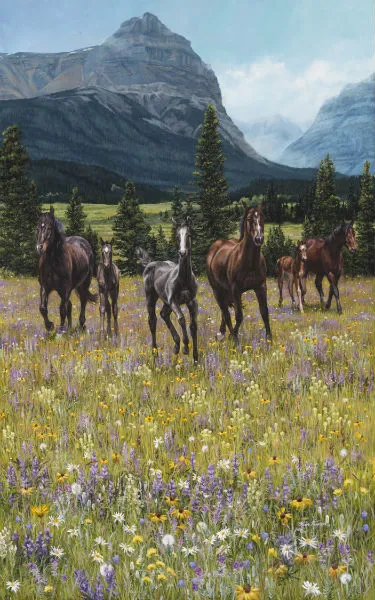
At first glance, Springtime Arrangement looks like a moment that might have unfolded all at once: young horses moving through wildflowers, dark evergreens holding the middle distance and mountains rising beyond them. In fact, Kim Penner assembled the painting from separate observations and memories until they felt like one place.
Kim regularly works from her own reference photography. A horse may turn for only a second, light may shift across a field, and flowers may bloom in a different season from the mountain view needed for a composition. Photography preserves those pieces; painting is where Kim decides how they belong together.
For Springtime Arrangement, she drew from as many as six or seven reference images. Details from horses, flowers, forelocks, manes and distant landscape were brought together rather than copied from one photograph. Each element had to share believable light, movement and space within the finished scene.
The Ya Ha Tinda horizon
The landscape draws from the country around Ya Ha Tinda Ranch, west of Sundre, Alberta. Parks Canada operates Ya Ha Tinda as a working horse ranch, where horses are trained and wintered for work in Canada's western national parks. Its grasslands, forests and mountain edges give the area a character familiar to generations of Alberta riders.
Warden Rock anchors the painting's horizon. It is not the loudest element in the composition, but it gives the scene its place. The flowers and moving horses carry the foreground energy, while the ridge and mountain forms create distance and permanence behind them.
People familiar with the area have sometimes thought the horses looked like the free-roaming horses of the surrounding country. Kim clarified when the painting was featured by Horses All that they were not intended as a literal depiction of those horses. The scene is a composition shaped from horse and landscape references, not a documentary record of one herd in one meadow.
That distinction reveals an important part of Kim's process. Reference provides visual evidence: the bend of a knee, the fall of a mane, the pattern of flowers or a precise horizon. Composition asks a different question—how those details can work together to create rhythm, clarity and feeling.
Arranging movement without losing calm
The word “arrangement” suits the painting. Each horse contributes to the rhythm of the group. Changes in direction and overlap make the movement feel natural, while the broad meadow keeps the scene open and calm.
Colour reinforces that balance. The bright meadow draws the eye into the foreground, deeper evergreens slow it through the middle distance, and cooler mountain tones open the horizon. The horses remain distinct, yet they read as a band moving through the same air.
Kim's daughter Amanda helped title the work. Naming paintings has often been a family conversation in the Penner studio. A well-chosen title can guide a viewer toward a work's spirit without prescribing a single interpretation. Springtime Arrangement speaks both to the carefully constructed composition and to the ease with which nature appears to have arranged the scene.
From the original to the limited editions
The original measured 30 × 48 inches and sold for $15,000. Horses All featured the painting on the cover of its May 2012 issue. At that scale, the small anatomical and landscape details had room to coexist with the wide sweep of the meadow.
The current Kim Penner catalogue lists Springtime Arrangement as a limited-edition canvas in two sizes. The 20 × 32-inch format has a signed-and-numbered edition of 50 and an artist's-proof edition of five. The 28 × 44-inch format has a signed-and-numbered edition of 30 and an artist's-proof edition of three. These figures describe the complete edition sizes, not remaining inventory.
Both formats preserve the original's relationship between horses and landscape. The smaller canvas brings the complete composition into a more compact room, while the larger format gives the details and distance room to breathe.
Years after it was painted, Springtime Arrangement continues to demonstrate how Kim works: direct observation establishes the horse and the landscape, while composition transforms separate references into a scene that could not have come from any single photograph. It is not a record of one spring afternoon, but an arrangement of many real moments into one lasting place.