At the Royal Manitoba Winter Fair in 2015, Kim Penner was asked what it takes to paint a horse convincingly. Her answer was simple: “People who know horses can tell.”
Horse people spend years reading an animal without needing words. They notice where the weight has settled, what an ear has turned toward and how a horse is preparing to move before it takes a step. That familiarity creates an exacting audience for equine art. A painting may be beautifully coloured and carefully finished, but if the horse does not feel structurally and emotionally true, something remains unsettled.
For Kim, accuracy is not a display of technical knowledge for its own sake. It is the foundation that allows a particular horse to feel present.
The whole horse comes before the details
A horse is not a collection of individually correct parts. The eye, shoulder, hock and hoof can each look plausible on their own, yet the animal can still feel wrong if those parts do not belong to the same posture and moment.
The first question is larger: does the horse balance?
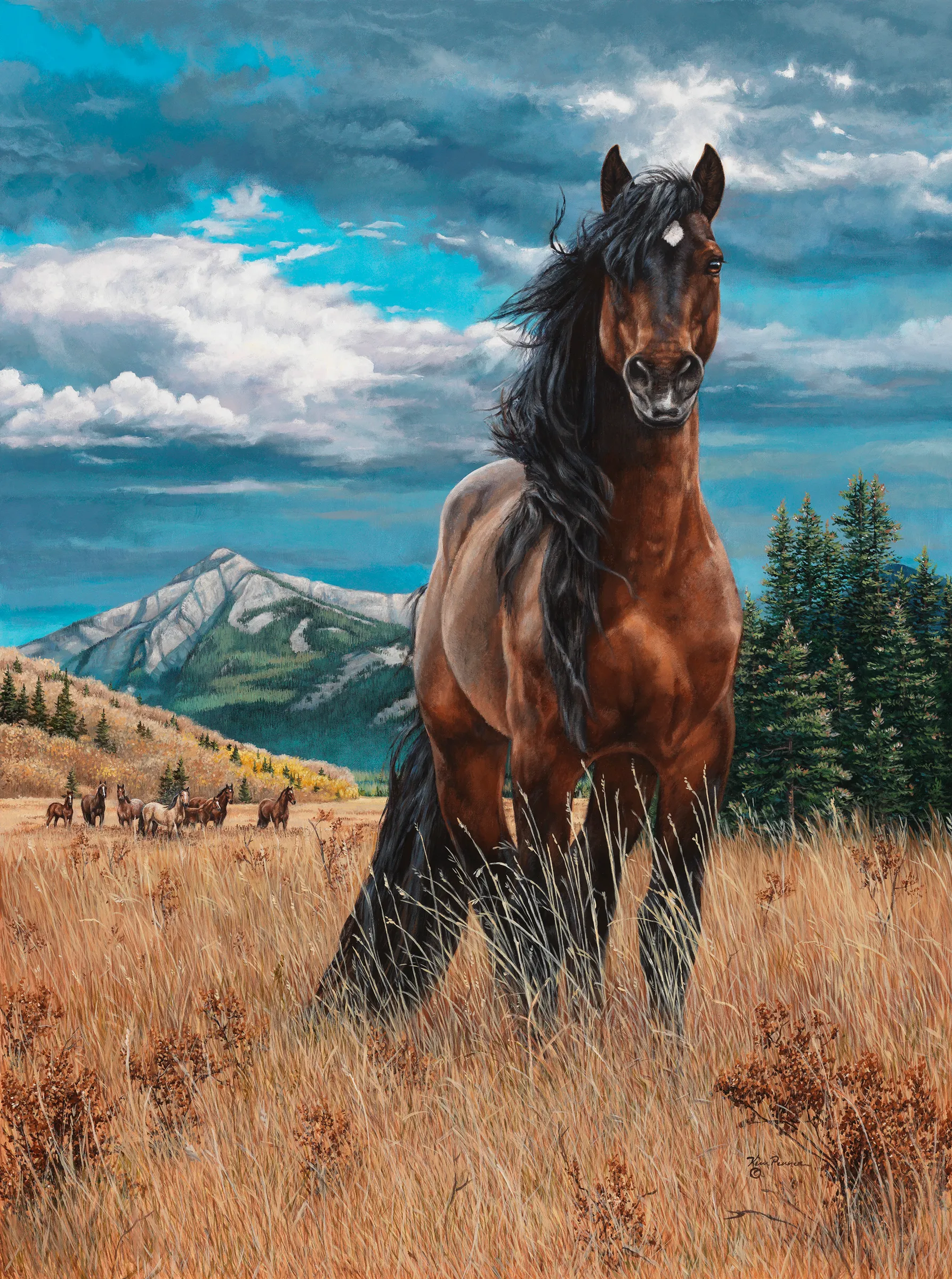
The line through the back, the angle of the neck, the placement of the feet and the direction of the head all contribute to a single gesture. A standing horse may be square, resting a hind leg, leaning toward a companion or listening to something outside the frame. A moving horse must carry its energy through the entire body. Even a quiet scene contains direction and intention.
This is why silhouette and proportion matter. Before a viewer notices the gleam in an eye or the fine hair along a muzzle, the body has already communicated whether the horse feels alert, relaxed, powerful, hesitant or at ease.
Weight must have somewhere to go
Horses are substantial animals. Their weight cannot float above the ground, and motion cannot happen independently in four legs. A convincing pose needs a believable centre of balance and a clear relationship between the body and the feet beneath it.
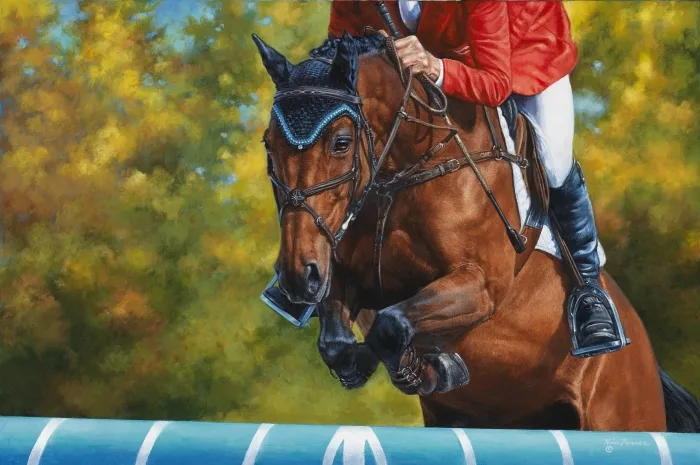
That becomes especially important in scenes of running horses, deep snow or moving water. The landscape is not merely a backdrop. Snow receives the hoof, water breaks around the leg and dust follows the direction of travel. Those points of contact help the viewer feel mass, momentum and footing.
In a quieter portrait, the same principle applies more subtly. A lowered head changes the topline. A resting hind leg shifts the pelvis. A horse reaching toward another changes the arrangement of the neck and shoulders. These structural relationships are what make a pose feel observed rather than assembled.
Kim grew up with horses and has painted them for more than three decades. That long familiarity underpins the anatomical precision for which her acrylic work is known. It also gives her a working knowledge of the difference between a pose that is merely possible and one that feels natural to the animal.
Expression is carried through the body
People often look to the eyes first, but equine expression is rarely contained in the eyes alone. It is distributed across the horse.
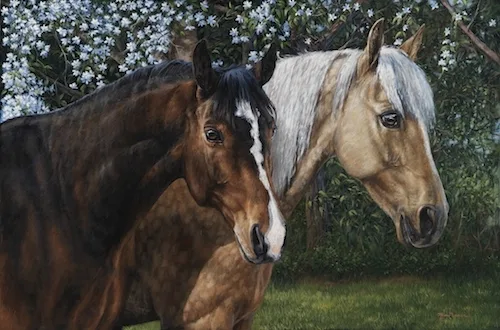
The ears indicate attention. The muzzle can appear soft or held. The set of the neck, the distance between two horses and the direction of their bodies can suggest trust, curiosity, vigilance or companionship. A mare bending toward a foal does not require a human expression placed upon her; the relationship is already visible in posture and proximity.
The most convincing equine art does not turn a horse into a person in a horse’s body. It recognizes the emotional information horses genuinely provide and preserves it without exaggeration.
This is also why individual character cannot simply be added at the end. Markings help identify a horse, but personality comes through the entire pose: the familiar tilt of a head, a particular steadiness or the way the animal occupies space beside another.
Reference photographs are evidence, not the whole answer
For a commissioned portrait, photographs are essential. They document markings, conformation and the details that make one horse unmistakably itself. They can also catch a fleeting expression that the owner recognizes immediately.
But a photograph records only a fraction of a second, from one lens and one point of view. It may freeze an awkward stage of a stride, hide a leg or flatten the relationship between the head and body. Creating a coherent painting requires understanding what the photograph contains rather than reproducing every accident of the camera.
Kim’s commission process therefore begins with a conversation about the horse, the setting, the intended mood and the available reference images. She works from the client’s photographs and her own studies, then develops a composition for approval before the painting begins. The images provide visual facts; the owner’s knowledge helps identify which details are characteristic of the horse and which belong only to that instant.
Accuracy makes room for feeling
Technical accuracy and emotion are sometimes treated as opposites, as though realism leaves no room for interpretation. In equine painting, the opposite is often true. Once proportion, balance and gesture are secure, the image no longer has to persuade the viewer that this is a horse. It can concentrate on which horse, which moment and why that moment matters.
That is the standard knowledgeable horse people bring to equine art. They are not only checking anatomy. They are recognizing a language they already understand: the shift of weight, the turn of an ear, the space between companions and the energy held just before movement.
When those elements agree, the horse does more than look correct. It feels known.